







Solutions / Private ASR (Speech-to-Text, STT) — Enterprise Speech Recognition System for Business
Private ASR is a speech recognition system that runs on a server inside your company's network. It converts phone call recordings into text, separating the agent's and the customer's lines. Audio files and transcripts are never sent to cloud services or external APIs.
The system is built for the real-world conditions of call centers and sales departments in Kazakhstan and Uzbekistan: telephone-grade audio quality, colloquial speech, and code-switching — Russian mixed with Kazakh, or Russian mixed with Uzbek within the same conversation.
We use open-source models, so there are no per-minute licensing fees for transcription.
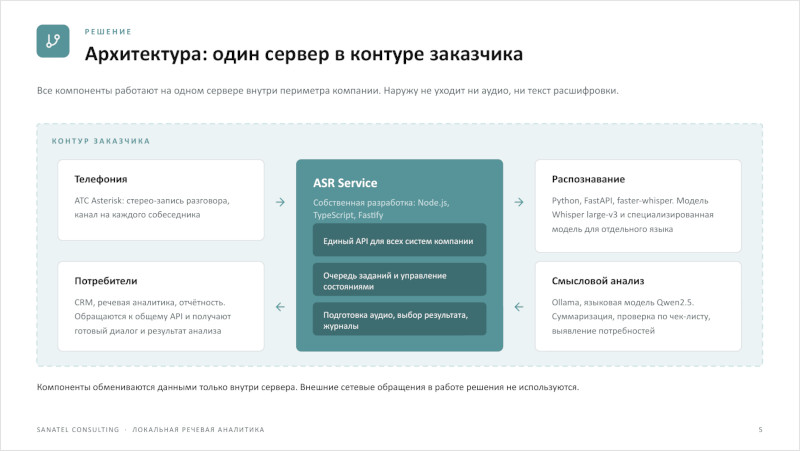
Local ASR server presentation slides:
Why Run Speech Recognition On-Premises
- Confidentiality. Customer calls contain personal data, deal terms, and commercial information. With cloud services, this data ends up on third-party infrastructure, often outside the country.
- Data Localization. Recordings and transcripts remain within the client's territory and infrastructure, simplifying compliance with personal data storage regulations.
- Total Cost of Ownership. Cloud transcription is billed per minute. With thousands of calls per day, a dedicated server pays for itself quickly — after that, transcription costs nothing beyond electricity.
- Quality Control. The model, vocabulary, and processing rules are tailored to your specific conversations rather than an average cloud service user.
System Capabilities
- Batch transcription of PBX call recordings (including Asterisk) in telephone quality — 8 kHz, MP3.
- Speaker separation via stereo channels: agent and customer lines are transcribed separately, avoiding automatic diarization errors.
- Russian, Kazakh, and Uzbek languages, including mixed speech within a single call.
- Punctuation restoration and segmentation into speaker turns with timestamps.
- Custom industry vocabulary — model names, products, and services — for higher accuracy on domain-specific terminology.
- Automatic rejection of recordings where speech could not be recognized: these files are flagged so they do not skew analytics.
Transcripts are passed to speech analytics for call topic and outcome detection, emotional tone analysis of both parties, and sales script checklist verification. Semantic analysis is performed by a local language model on the same server.
Technical Architecture
1. Recognition Models
Built on Whisper large-v3 running on the faster-whisper (CTranslate2) engine. For the Uzbek language, we use a proprietary fine-tuned model. We continuously benchmark new open-source models on real production recordings and upgrade whenever testing shows measurable gains.
2. Multi-Pass Ensemble
Code-switching is the weakest spot of general-purpose models: automatic language detection fails when two languages are spoken in the same call. To solve this, each channel is transcribed in three passes: once with auto-detection, and once with each language in the pair forced (for example, Kazakh and Russian). The best output is selected based on model confidence, share of recognized speech, and segment count.
3. Protection Against "Hallucinations"
Whisper-family models occasionally generate text that was never spoken in the recording: subtitles, loops, or phrases in another language. Six filters strip out these artifacts, checking for intra- and inter-segment repetitions, invalid writing scripts, known boilerplate phrases, implausible speech rates, and other anomalies. The raw transcription output is preserved unchanged, allowing any post-processing step to be audited.
4. Processing Service and API
- REST API with token-based authentication and schema request validation;
- Asynchronous job queue: your system submits a recording and retrieves the result once ready;
- Parallel audio preprocessing, transcription, and analysis — while one recording is being transcribed, the next is already being prepared;
- Logs and monitoring dashboard: jobs by status, processing time, transcription quality, and GPU temperature.
Via the API, the system integrates with CRM, PBX, BI, and other internal platforms.
Security and Privacy
- Dedicated installation for each client — on your server in your server room or in your own data center rack. There is no shared cloud or shared database with other clients.
- All models run locally. Audio and text are never transmitted to model developers or to us.
- Minimal data retention. Temporary audio files are deleted immediately after transcription, and completed jobs with results are purged after 24 hours. Your PBX or CRM remains the permanent storage for recordings.
- Your data stays yours alone. If a model is fine-tuned on your recordings, it happens strictly within your perimeter, and your data is never used for other clients.
Deployment Options
- Dedicated server on company premises;
- Company-owned rack or dedicated server in a data center;
- Isolated virtual machine with GPU within the company's infrastructure.
Local Server Requirements
An enterprise-grade GPU is not required — a consumer gaming graphics card with 16 GB of VRAM is sufficient.
- GPU: GeForce RTX 5060 Ti 16 GB, RTX 4080 / 5080 (16 GB), or RTX 3090 (24 GB);
- Effective case cooling — speech recognition places a continuous load on the GPU;
- CPU: 6+ cores with AVX2 support;
- Storage: 500 GB+ SSD;
- Operating system: Ubuntu 24.04, including inside a KVM virtual machine.
Performance benchmark: approximately 30 seconds for a 2–3 minute call using three-pass transcription across two channels. Including semantic analysis, a single server processes up to 3,000 calls per day.
Implementation Scope
- Requirements analysis and infrastructure audit;
- Recognition accuracy benchmarking on your recordings and model selection;
- Server hardware sizing and configuration;
- Deployment and setup;
- Integration with PBX, CRM, and internal systems via API;
- Integration with speech analytics;
- Custom industry vocabulary setup and model fine-tuning, if needed;
- Staff training, technical support, and maintenance.
See Also
Private IDP — document package recognition and verification on the same platform, also deployed within your perimeter.